Jake returns to Chicago for Helen
Happiness for BeginnersJake returns to Helen not because his journey has ended, but because an accidental phone call makes continuing without speaking to her impossible. His arrival at a party where Helen is trying to leave transforms a detour prompted by Duncan’s alarm over Pickle into a deliberate return for her; the conversation that follows gives that choice its full weight by exposing both Jake’s love and his fear of a future in which he will lose his sight.
The Interrupted Journey
Jake’s return begins with a call he initially understands as Helen contacting him. He had stopped for the night while traveling, and when his phone rang, he answered. Helen had not meant to call: it was a pocket dial. That distinction matters to the episode’s emotional turn. The call was accidental, but Jake’s decision to listen was not. When Helen later objects that he should have hung up rather than eavesdrop, he explains that he could not bring himself to end the call. Hearing her, even without her knowledge, made him recognize how much he wanted to remain connected to her.
The moment changes the direction of his trip. Jake says that the next morning his Land Rover seemed to take him home by itself. The image gives his return a quality of instinctive momentum, but his account makes clear that he then chooses what to do: he comes to find Helen and talk to her. He still expects to continue his journey after a day or two, and the Whales he had planned to see remain on his itinerary. Returning for Helen is therefore not presented as the cancellation of every other intention; it is a choice to put an urgent conversation first.
A Return at the Party
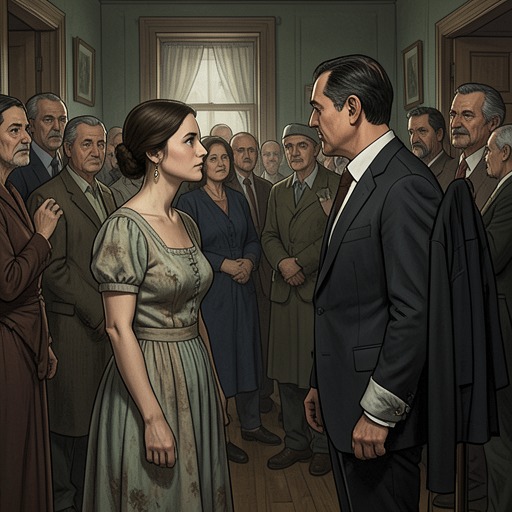
Helen encounters Jake while trying to make her way out of a crowded party. She has been moving with her eyes down, hoping that leaving the room might help her feel better, when she walks straight into someone’s chest. The person is Jake, whom she had last associated with his departure and Windy. His sudden presence interrupts her attempted escape before she reaches the exit.
His appearance makes the encounter feel newly charged. Jake is clean-shaven and wearing glasses, an Oxford shirt, and a narrow tie; Helen has never seen him in a tie, not even at her wedding. She registers him as composed, grown-up, and more handsome than she remembers. The contrast between his polished appearance and the unexpectedness of his arrival sharpens the reversal: the man she thought had gone is standing directly in front of her, while she is still trying to get away from the party.
Jake gives a practical reason for being there before explaining the more intimate one. Duncan had left a panicked message about Pickle, afraid that he might not survive the night. Helen tells Jake that the situation has been handled. The message accounts for his immediate involvement in the crisis, but it does not fully account for why he has come to speak with her. The distinction between responding to Duncan’s alarm and choosing to return for Helen becomes central as Jake explains what happened on the road.
What the Pocket Dial Reveals
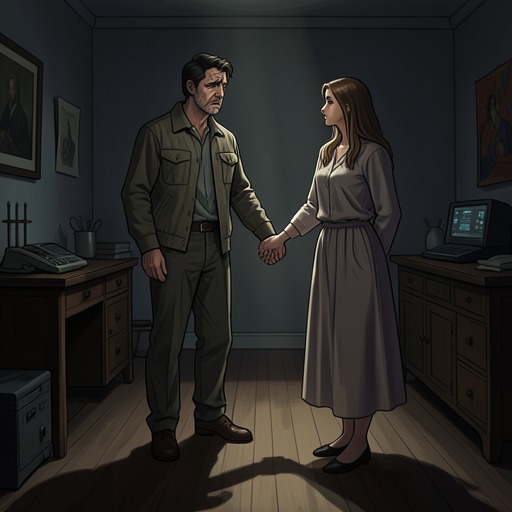
The accidental call lets Jake hear Helen speak without knowing he is listening. He describes being caught by the experience: what began as the appeal of overhearing her becomes the realization that he would rather listen to her than do almost anything else. He considers several reasons to stay away, including the possibility that Helen cannot stand him, that she deserves someone better and healthier, and that leaving her alone might be the decent course. Yet he tells her that these considerations do not overcome his desire to go after her. His return is framed not as a calculated romantic tactic but as the consequence of recognizing what he wants and acting on it.
The episode also connects that choice to Jake’s diagnosis. Earlier, he had explained that he canceled his place on the wilderness trip because of trouble with his eyes. Examinations and tests revealed an inherited vision disorder that could not be fixed; night blindness was only one part of it. By the time of the later conversation, he has spent a year searching for information and understands the outlook as a gradual loss of sight, with no treatment capable of changing the outcome. He describes himself as waiting for the light to go out.
That knowledge had already remade the future he imagined. Jake had expected to become a doctor, have children, and learn to scuba dive. Once he knew the seriousness of the diagnosis, those ambitions seemed to him to be disappearing. His father’s nickname for him, Doc, carries a related pressure: Jake says his father sees the high-achieving, hard-working, valedictorian son he always expected him to become. The diagnosis thus unsettles not only a career plan but also the identity his father has held for him.
Speaking at Last
In the conversation after his return, Jake explains that he had not been certain about the severity of his condition until shortly before reaching Wyoming. He had gone through denial and bargaining while undergoing tests, and once he knew for sure, he could not eat or breathe easily. He dates that certainty to the day before Helen appeared at the party with Pickle. The timing complicates the return: Jake’s decision to come toward her follows a period when the future he wanted seemed to have vanished, but it does not mean the diagnosis has become less real.
Jake says that, once he understood what lay ahead, he stopped considering asking Helen out. He believed she had not liked him even when his vision was normal, and he feared that asking her to share a life with him would be unfair. At the same time, he admits that he cannot simply leave her alone. His return therefore carries two opposing truths: he wants a future with Helen, and he believes the progressive loss of his sight may make him a burden or make that future impossible. By coming back and speaking plainly, he stops treating silence as protection and allows Helen to understand both his desire and the condition shaping his choices.
The episode’s resolution is a disclosure rather than an immediate answer to those fears. Jake returns because the pocket dial forces into focus how much he wants Helen, then tells her that his sight will continue to deteriorate. The journey home becomes a first act of honesty: he does not pretend that love can reverse the diagnosis, but he no longer uses the diagnosis as a reason to disappear from Helen’s life without telling her what he feels.